


Marian Malowist Seminar. “Whose Nation? Hungarian and Polish Revolutionaries Among Conflicting Loyalties”
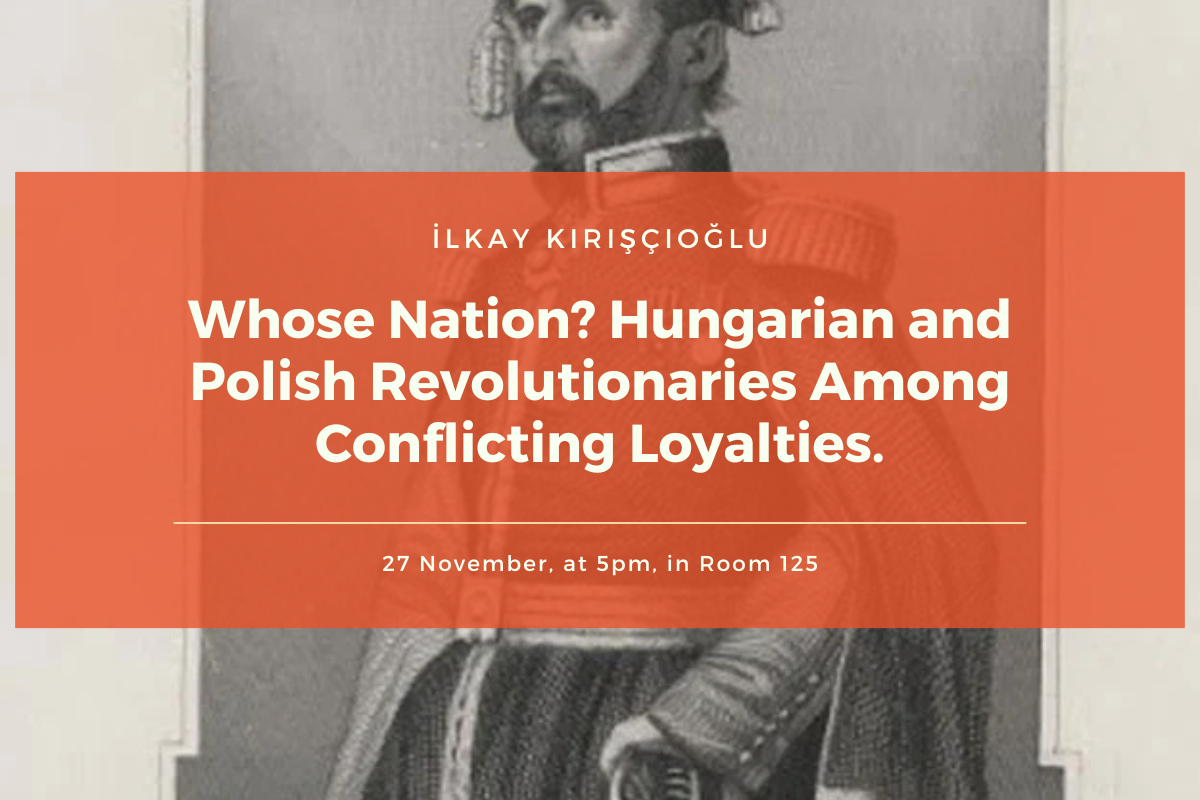
Please join us for a lecture as part of the Marian Malowist Global History Seminar entitled: “Whose Nation? Hungarian and Polish Revolutionaries Among Conflicting Loyalties”.
The lecture will be given by İlkay Kirişçioğlu.
The event will take place on 27 November, at 17.00, in Room 125. You are cordially invited to attend.
Broadcast link: meet.google.com/jes-vvnp-qxu
Abstract:
Hungary’s quest for freedom was suppressed by the joint army of Tsarist Russia and the House of Austria in 1849, after which thousands of Hungarian, Polish, and Italian revolutionaries sought asylum in the Ottoman Empire. Since their arrival aroused vehement protests from Austria and Russia, the Sublime Porte likely induced the refugees to adopt the creed of Islam to alleviate diplomatic pressures. While some refugees, led by General Józef Bem, voluntarily converted to Islam, others, mostly the upper echelon of the movement, particularly Lajos Kossuth, bitterly declined the offer and excommunicated the converts. Unlike the refugee leaders who left the Ottoman territory for Europe and America in September 1850, hundreds of converts were employed in the Ottoman army and bureaucracy, starting a new life within the empire. Owing to this engagement, their divergence from the revolutionary elites continued to widen in the years to come, though studies influenced by state-centric narratives always preferred giving voice to the leaders; little is known about the rest, such as the Muslim converts, despite their significant number. This presentation concerns the "little men" among Hungarian and Polish political migration to the Ottoman Balkans, since the converts were typically young without much formal power, authority, reputation, and prestige, unlike the illustrious leaders who had widespread domestic and international prestige and publicity. My main argument is that the political tradition of 19th- century converts gradually converged with the broader social imaginations of the wider geo- cultural regions, while simultaneously diverging from their narrowly defined ethno-religious genres, hinting at a more inclusive political culture than what the nation-state paradigms of the 20th century typically offer. After interpreting the identity shift the revolutionary converts might have undergone from the late 1840s to the early 1860s, this presentation seeks to introduce a new case study focusing on Mustafa Celaleddin Pasha (Konstanty Półkozic- Borzęcki) to put my research findings to a test, adding nuance and depth to the understanding of the religious conversion among European revolutionaries on Ottoman soil.
İlkay Kirişçioğlu is a historian of nineteenth-century Europe and the Ottoman Empire, with a particular focus on the revolutionary networks that connected Hungarian, Italian, and Polish lands under Austrian and Russian rules with the Balkans under Turkish rule. He recently defended his PhD thesis, “Garibaldi’s Sword of Glory: Hungarian and Polish Converts in Constantinople,” which deals with the transnational encounters of the Hungarian and Polish 48ers who converted to Islam in the Ottoman Empire in the late 1840s and later developed close relations with the Italian revolutionary circles in the early 1860s. His broader research interests include the revolutionary networks in Europe and their entanglements in the territories of the Ottoman Balkans in the second half of the nineteenth century, along with ego-documents, religious conversion, transnational mobility and police surveillance during the long nineteenth century.